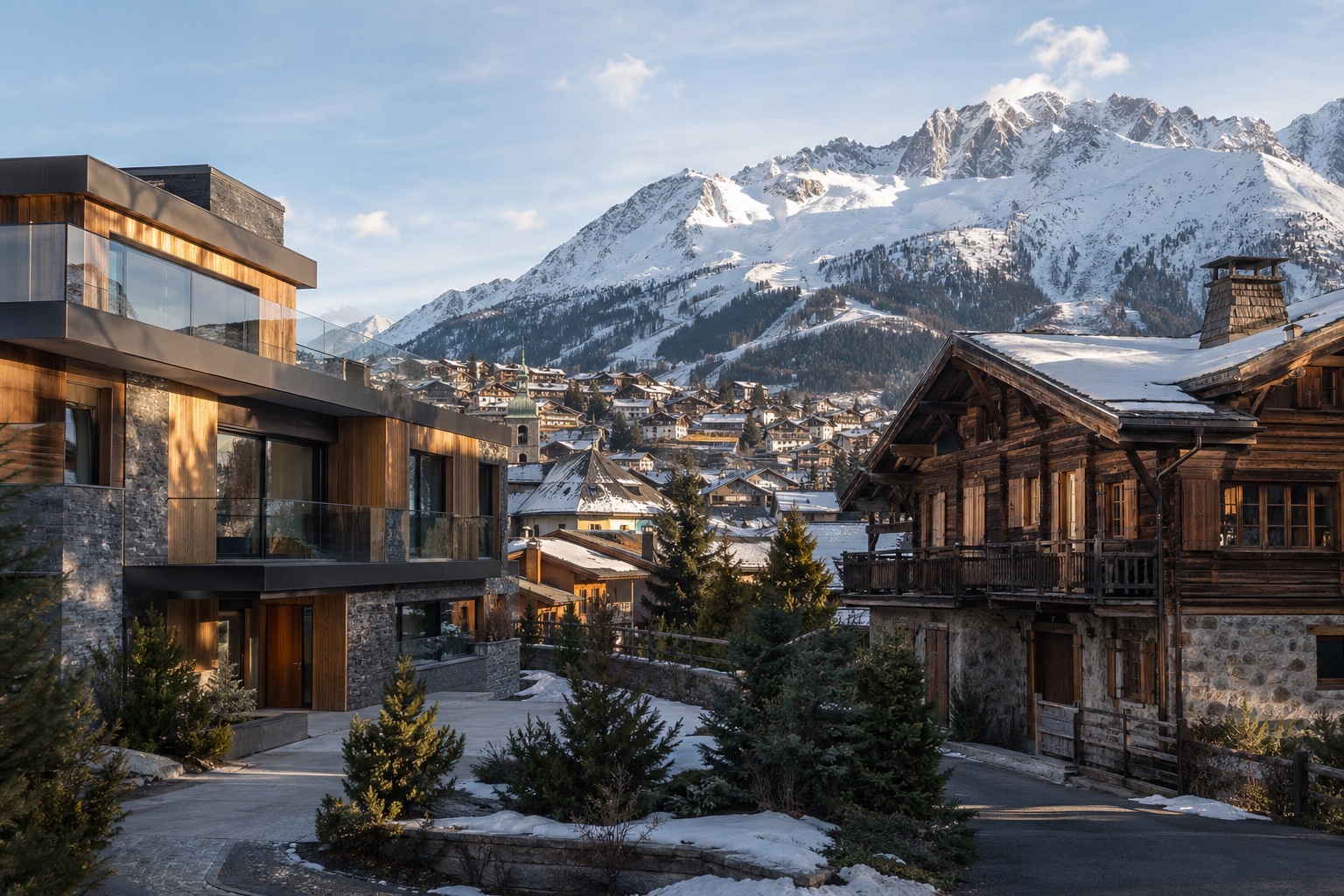
The French Alps ski property market in spring 2026 presents buyers with a deceptively simple question: new-build or resale? On the surface it looks like a matter of taste — a shiny off-plan apartment with a decade-long warranty versus a lived-in chalet you can inspect room by room. In practice, the choice is a genuine investment decision with meaningfully different risk and return profiles, and the answer depends far more on your goals, timeline, and tax position than on the finish of the kitchen worktops.
The New-Build Case: Tax Advantages That Are Hard to Ignore
France's LMNP (Loueur en Meublé Non Professionnel) regime remains the single most compelling financial reason to buy a new-build ski property in 2026, even after the reforms announced in the 2025 Finance Act. Under a résidence de tourisme structure, buyers can still recover the 20% TVA (VAT) on the purchase price — a saving worth €100,000 or more on a €500,000 apartment — provided the property is operated through an approved management company for a minimum of nine years.
On top of the VAT reclaim, new-build buyers benefit from reduced frais de notaire (notary fees) of roughly 2–3%, compared with 7–8% on a resale. On a €600,000 purchase that difference alone is €24,000–€30,000 — money that either stays in your pocket or compounds inside the investment from day one.
Construction quality is the other new-build advantage that buyers increasingly value. French thermal regulations (RE 2020) mean that anything completed from 2022 onward must meet strict energy-efficiency targets — lower running costs, better insulation, and higher EPC ratings that will matter progressively more to future resale buyers as Europe's energy-efficiency legislation tightens through the decade.
The Resale Case: Immediate Income and Full Transparency
A well-chosen resale property in an established French Alps resort offers something off-plan cannot: certainty. You can see exactly what you are buying, inspect the syndic accounts, review the building's maintenance history, and — critically — evaluate actual rental income figures rather than developer projections.
In the high-altitude resorts where Domosno operates, resale stock in 2026 is genuinely scarce. Inventory in Courchevel, Val d'Isère, Méribel, and Tignes remains historically tight, with fewer than 80 apartments priced above €500,000 available across all four resorts combined at any given point this winter. Scarcity supports prices, but it also means that when a good resale surfaces it moves quickly — often within weeks of listing, frequently at or above asking price in the prime ski-in ski-out segments.
For buyers who want rental income from their first season, a ready resale is the only viable route. New-build delivery timelines in the Alps currently average 24–36 months from reservation to handover, meaning a buyer committing today is unlikely to welcome their first tenants before winter 2027–28 at the earliest.
Yield Comparison: What the Numbers Look Like in 2026
Gross rental yields across the main French Alps resorts currently range from around 3.5% to 5.5% per annum, with the higher figures concentrated in mid-altitude resorts — Les Gets, Châtel, La Clusaz — where purchase prices are lower relative to strong, broad-based rental demand. The ultra-premium resorts (Courchevel 1850, Val d'Isère village centre) tend to deliver gross yields of 3–4%, with the investment case resting more on capital appreciation than income.
New-builds in résidence de tourisme structures typically quote guaranteed yields of 3–4.5% net of management fees during the initial lease period. Resale properties managed independently — or through flexible management platforms — can outperform these figures in strong seasons, but carry more variability and require more active owner involvement.
The VAT reclaim on a new-build substantially enhances effective yield in the early years. A buyer recovering €80,000 of VAT on a €400,000 net purchase is effectively investing €320,000 for an asset with a market value of €400,000 from day one — a 25% immediate paper gain that resale buyers cannot replicate.
Capital Growth: Reading the 2026 Data
Both markets have delivered strong capital growth over the past decade. French notarial data for Savoie and Haute-Savoie shows average price appreciation of 42–55% in the decade to 2025, with the top resorts outperforming significantly. Méribel's 51% five-year gain — documented in detail in our April 2026 market report — is the headline figure, but quieter resorts like Vaujany and Les Menuires have quietly delivered comparable or better percentage gains from a lower base.
New-build pricing in 2026 reflects high construction costs, developer margins, and strong demand — meaning off-plan buyers in prime locations are often paying close to or at the top of the current market. The growth story for new-builds is therefore more dependent on where the overall market goes over the next five to ten years than on an immediate discount. Resale buyers with the patience to find mispriced stock — properties in excellent locations where vendors are motivated — can still find value that is harder to access in the new-build segment.
The Practical Decision Framework
Before choosing between new-build and resale, serious buyers should answer four questions honestly:
1. What is your investment horizon? If you plan to hold for fewer than five years, a new-build's VAT lock-in period (nine years to avoid claw-back) creates a meaningful exit constraint. Resale offers more flexibility.
2. Do you want to use the property personally? Off-plan résidence de tourisme contracts typically restrict personal use to a fixed number of weeks. Resales managed independently or through flexible platforms offer greater personal use freedom.
3. Is tax optimisation a priority? If recovering VAT and minimising notary costs are central to your financial plan, new-build wins on structure. If your priority is simplicity and immediate income, resale is cleaner.
4. How much illiquidity can you tolerate? Committing €600,000+ off-plan for 36 months — with stage payments tied to construction milestones — requires confidence in your liquidity position over that period. Resale is a simpler exchange transaction.
Our View for 2026
Both strategies remain sound in the current French Alps market. New-build makes most sense for buyers with a long investment horizon, appetite for the VAT structure, and flexibility on personal use. Resale suits buyers who want immediate returns, full transparency, and the freedom to manage their asset independently.
The real mistake in 2026 is inaction. Inventory at both ends of the market is thin, prices continue to trend upward, and the window to purchase at current valuations before the 2030 Winter Olympics price cycle intensifies is narrowing. Whether you choose off-plan or existing stock, the key is moving with a clear brief, trusted local advisors, and a realistic assessment of your own goals.
Domosno specialises in both new-build and resale ski property across the French Alps. If you would like a tailored comparison of specific properties matching your investment profile, speak with our team.